- The906Report
- Posts
- Subscriber Insider

In This Issue
Statement of principles
Content drop: Closed mines require long-term care
Personal note: Who am I? (establishing my bona fides)
Curated content: Mining remains crucial to Marquette County economy
Coming attractions
Tell your friends!

Content Drop
Closed mines may need 1,000+ years of care, expert says
Tailings dams and other reclaimed mine facilities “may need care and maintenance exceeding 1,000 years,” according to Peter Werner, a mining engineer with the U.S. Forest Service, writing in a December, 2025, article in Mining Engineering, a professional trade magazine.
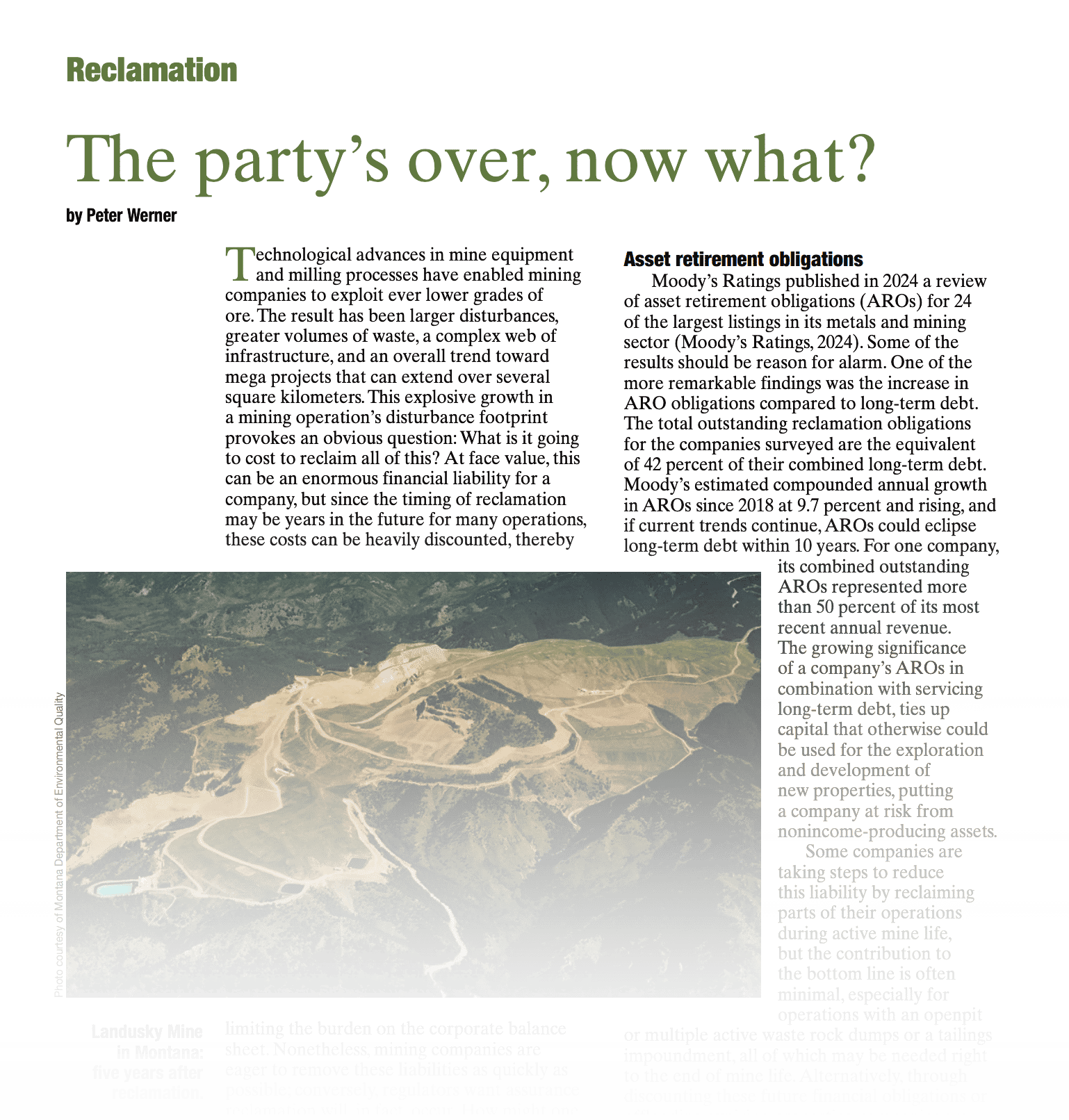
Landforms such as mine pits, tailings impoundments and waste rock piles “will continue to change in shape and size in response to climatic and environmental forces” long after a mine is closed, Werner said, so monitoring and maintenance of retired mines “should be viewed in terms of geologic time and not simply in engineering time.”
Retired mines have components that require ongoing maintenance, such as geomembrane liners and covers, underdrains and seepage collection systems, passive dewatering and water treatment systems, and pipeline valves, couplers and gauges, Werner said in the Mining Engineering article. “To assume these systems will function as designed indefinitely [post-closure] is misguided.”
Long-term natural processes, such as wildfires, slope creep, storm runoff, and freeze-thaw cycles will inevitably degrade infrastructure after mine closure, possibly “leading to … acute nonperformance and eventual system-wide breakdown,” Werner said, citing an unpublished Forest Service risk assessment.
Analysts who conducted the study concluded that “the only solution to maintaining system performance was a commitment to site care and maintenance — well, forever,” Werner wrote in the Mining Engineering article.
Even simple care and maintenance of a closed mine site “can run tens of thosands of dollars per year,” Werner said, which explains why it is common practice for mining companies to offload expiring properties “to avoid a balance sheet awash in red ink.”
In Michigan, 20 years is the default post-closure monitoring period under Part 632 of the state’s Natural Resources and Environmental Act (NREPA). After that, a mine owner can get a “certificate of completion” from the Dept. of Environment, Great Lakes, and Energy (EGLE) that closes out its permit obligations, though it remains liable for future environmental damage, if that occurs.
Personal note: Who am I?
Here’s some more about me, so you know who’s talkin’ at you. (Continued from the Nov. 18 subscriber newsletter).
I am a journalist, first and foremost, though I spent much of my professional life working as an administrator for the University of Wisconsin in Madison and Milwaukee.
My first real news job was “Upper Peninsula Bureau Chief” for WFRV-TV. That was in 1979-80. I drove 44,000 miles, alone, producing daily news reports until I figuratively ran out of gas and asked for a transfer to the station in Green Bay.
Did some other news gigs, then got a law degree and switched to a desk job with the UW, which was then, and remains, a world-class center of research and learning.

Long ago and far away.
I have a law degree from the University of Wisconsin
I have a second home in the Upper Peninsula of Michigan
I have been writing and making short films about mines and the environment since 2015
You can see my reporting at https://www.facebook.com/906report
You can learn more about me at https://coldtype.org/
I make zero money from any of this; I do it because, well, it’s what I do (once a journalist, always a journalist)
Curated content: Mining remains crucial to Marquette County economy, despite efforts to diversify
Business leaders are looking to reduce dependence on the volatile mining sector.
Coming attractions
Gold Resource Corp., "has made a strategic decision to resume work on the Back Forty project in Michigan," according to a Dec. 3 news release.
With that in mind, I’m working on a recap of the 20-year, $100 million effort to establish the Back Forty mine on the Menominee River west of Stephenson, Michigan. Seems like the right time to review the Back Forty’s long and tangled history, and the so-far-successful grass-roots efforts to stop the project, given that the proposed mine has been off the radar for years, and is now reemerging.
Tell your friends!
If (as I hope) you find The906Report to be a useful resource, may I ask a favor?
Please encourage your friends and relatives to subscribe to this (always free) newsletter about mines, the environment and Upper Peninsula-oriented miscellany.
A large subscriber base is leverage for me as a reporter. If I have a big audience, politicians and corporate officials will find it harder to ignore me when I contact them for information.
Plus, I’ll have an added incentive to keep doing this work!
Please share this link: https://magic.beehiiv.com/v1/bb4ce63c-4062-4cd4-90d2-4977d4d4ae5a?email={{email}}
Thanks in advance for your support.